
Local Listings Management
Increase your share-of-voice in local search by promoting your business information!
Local Listings Management
That Puts Your Business on the Map
Local Listings Management refers to the process of ensuring that your business information is accurately and consistently represented across the online directories, search engines, and mapping services. This includes platforms like Google, Yelp, Bing Places, and many other local directories where customers may search for businesses in their area.
Effective local listings management involves creating and optimizing these listings to include essential information such as the business name, address, phone number (NAP), website URL, hours of operation, and a description of services. Consistency in this information across different platforms is also crucial for Google visibility in organic and local visibility (Google Local Pack).
Contact IIM today for your complementary Local Visibility Report to see if your business is visible at the local level. Local Search Marketing is not complicated and should be a part of every digital marketing campaign.
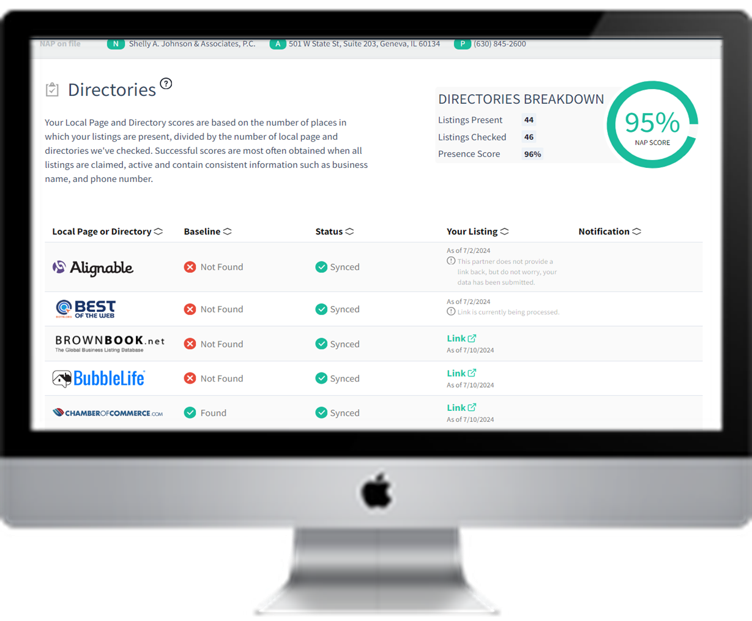
Boost Local SEO with Smarter Listings Management

Local Listings Management is essential for boosting local SEO, helping your business appear accurately and consistently across major directories like Google, Yelp, and Bing. Accurate listings build trust with search engines and customers, improving your chances of ranking in local search results and showing up in the high-visibility Local Pack. As a leading Chicago SEO firm, Incite Interactive Media (IIM) delivers expert Listings Management using advanced tools and real-time updates to keep your business information current across 70+ platforms. With IIM, you gain better local visibility, stronger credibility, and more customer engagement, all at an affordable price.
IIM's Approach to Local Listings Management
Directories & Search Engines
Voice Search Syndication
Data Aggregators Feeds
GPS & Navigation Syndication
How Local Listings Evolved Into a Key Element of Local SEO
Local Listings Management began long before search engines existed, rooted in print directories like the Yellow Pages, which launched in the late 1800s and became the original local business discovery tool. For decades, businesses competed for visibility based on category placement, ad size, and geographic reach. A strong Yellow Pages presence meant higher credibility and more inbound inquiries, setting the foundation for what would eventually become digital local search marketing.
The first major shift came with the rise of the internet in the 1990s, when local business directories moved online through platforms like Yahoo Local, MapQuest, and early search indexes. Listings were still simple name, address, and phone number, but now businesses needed to be discoverable in both digital maps and search results. This transition marked the beginning of structured NAP data (Name, Address, Phone) as a core component of local visibility.
In 2005, Google changed everything by introducing Google Maps and local business results, followed by Google Places and eventually Google My Business in 2014, which unified business data into one ecosystem. Around this time, other directories like Yelp and Bing Places gained momentum, and listings became more than basic contact info they included photos, hours, reviews, categories, and engagement features. Local Listings Management transformed into an ongoing marketing discipline instead of a one-time directory submission.
Today, Local Listings Management is a critical element of Local Search Marketing, directly influencing rankings in the Local Pack, Maps visibility, and customer trust signals like review activity and profile engagement. Modern listing platforms now push data across dozens of networks, apps, and voice assistants, requiring real-time updates, accuracy monitoring, and competitive category optimization. Businesses that actively manage listings win more impressions, more trust, and ultimately more leads.
The evolution from print to digital shows one constant: the brands easiest to find locally earn the most business. What started as a phone book placement strategy has become a sophisticated, data-driven local search engine signal system one that rewards consistency, engagement, and visibility across the entire local ecosystem.